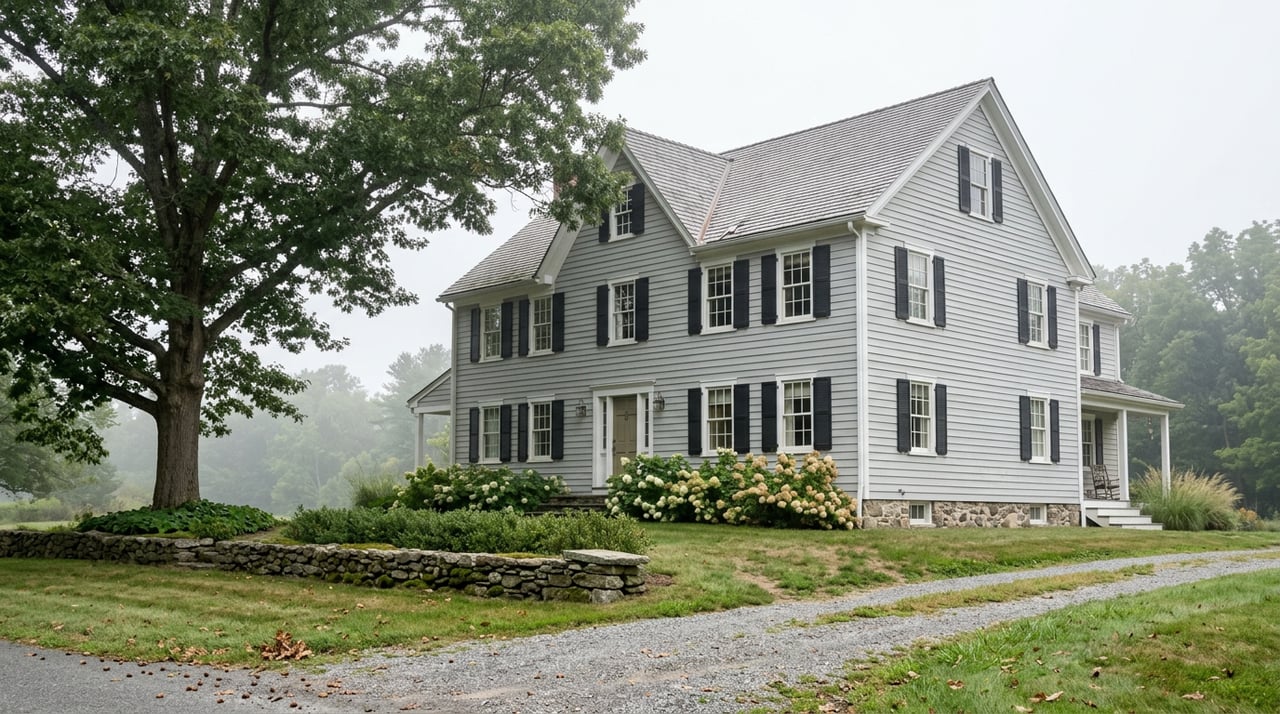
A buyer comparing a farmhouse in Redding to a Colonial in Darien will notice the price gap before they notice much else. Similar lot size, similar square footage, similar vintage of construction. One costs meaningfully more per square foot than the other. The easy explanation is schools, or proximity to the shoreline, or some intangible cachet attached to a town name. The actual explanation is fifteen minutes down the road, sitting on a set of rails.
Fairfield County is not one commuter market. It is at least three, and they are not divided by town line. They are divided by which Metro-North line reaches a given address, and whether that line runs electric straight to Grand Central or requires a diesel train and a platform change at South Norwalk.
The Mainline Gets the Express. The Branch Gets the Transfer.
The New Haven Line, the mainline that runs along the shoreline through towns including Greenwich and Darien, is a largely four-track electrified mainline capable of supporting a mix of local and express service, which allows for a higher density of stations than many other commuter rail lines. That infrastructure is why trains can arrive at Grand Central Terminal in as little as 45 minutes from Greenwich Station. Darien tells a similar story with two stations of its own, one downtown and a second at Noroton Heights a short distance north, giving mainline riders there the kind of scheduling flexibility a single-station town doesn't have.
Move inland and the picture changes. The Danbury Branch, which serves Ridgefield's Branchville station along with Redding, Wilton, and Cannondale, is not electrified, and uses diesel locomotives in push-pull operation, unlike the mainline or the New Canaan Branch. Most riders on this branch face a transfer. The Branchville station in southeastern Ridgefield offers service to Grand Central typically requiring a transfer at South Norwalk, with a total journey time of approximately 100 minutes. A Ridgefield commuter willing to drive north instead has a workaround: Goldens Bridge, just over the New York border, promises a 70-minute journey into Grand Central, close to mainline express speeds but on a different state's railroad entirely. Redding faces the same branch-line math. Commuters there travel to Grand Central via the Branchville, Wilton, Cannondale, or Redding stations, all on the Danbury Branch, all requiring that same South Norwalk connection.
New Canaan sits in its own category. The New Canaan Branch connects to Stamford, where riders transfer to the New Haven Line for service into Manhattan. It is a short branch with a guaranteed connection, faster than Danbury Branch towns but still a step removed from the direct-ride convenience that Greenwich and Darien residents take for granted.
Then there is New Fairfield, which doesn't appear in any Metro-North station list at all. No branch runs through it. The same is true of Sherman, tucked against the New York line on Candlewood Lake's western shore. The Danbury Branch ends in Danbury itself; neither town sits on the line. A buyer drawn to the lower price points in either town should understand that price partly reflects the absence of rail infrastructure within town borders, not just inland distance from the shoreline.
Here is what that infrastructure gap looks like against current sale data:
| Town | Line | Direct to Grand Central? | Typical one-way ride | Recent price signal |
|---|---|---|---|---|
| Greenwich | New Haven mainline | Yes | 45 min express | Median $3.0M, up 17.5% year over year (Jan 2026) |
| Darien | New Haven mainline | Yes | 45-90 min | Roughly $2.5M median |
| New Canaan | New Canaan Branch | No, transfer at Stamford | Varies | Closed-sale median swinging $1.4M-$4.3M by month |
| Ridgefield | Danbury Branch (Branchville) | No, transfer at South Norwalk | ~100 min | — |
| Redding | Danbury Branch | No, transfer at South Norwalk | ~90-100 min | Average home value $773,773 (May 2026) |
| New Fairfield | No Metro-North station | N/A | N/A | Median sold price $679,900 (Jan 2026) |
| Sherman | No Metro-North station | N/A | N/A | Median sale price $695,000, trailing 12 months |
Greenwich's median ran $3.0M or higher in early 2026, and 57 homes sold there in January 2026 versus 43 in January 2025, evidence of real depth of demand rather than a thin, easily-swung sample. Darien's median has been running closer to $2.5M. As of May 2026, Redding's average home value stood at $773,773, up 5.0% over the past year, and New Fairfield homes sold for a median price of $679,900 in January 2026. Sherman's median sale price over the trailing twelve months came in at $695,000, up 18% from the prior twelve-month period. The whole county, taken together, posted a median of $748K over the three months ending May 2026, up 8.4% year over year. But that countywide figure flattens a market that behaves like three or four separate ones stacked on top of each other, sorted by which platform a resident stands on at 7:15 in the morning.
New Canaan's Median Isn't Lying. It's Just Talking to Itself.
There's a second trap in this data, and it hits ultra-luxury markets hardest. In March 2026, New Canaan's median sale price was reported at $1.4M, down 17.1% year over year, and only 3 homes sold that month, down from 5 the year before. One month earlier, a different market report had New Canaan's story running the opposite direction: single-family homes in New Canaan achieved a median sales price of $4.3M in February 2026, well above the median list price of $3.04M. That's a swing of nearly $3M in the reported median from one month to the next, in the same town.
Neither number is wrong. Both are accurate readings of an actual month's closings. The problem is that a median calculated from three to five transactions isn't measuring the market, it's measuring whichever handful of houses happened to close escrow that month. Sell one $12M estate and one $1.8M cottage in the same thirty days and the median tells you almost nothing about where the next comparable listing should be priced. A steadier anchor is list price, where New Canaan's median list price runs around $2,646,511, a figure that moves far less month to month because it reflects seller expectations across a wider pool rather than a tiny cluster of closings. Anyone comparing New Canaan to a neighboring town using a single month's reported median is comparing noise to signal.
The Wire Mill That Could Redraw the Map
There's a live infrastructure story sitting in the middle of this branch-line divide, and it's worth knowing before it becomes obvious. The Gilbert & Bennett Wire Mill sits in Redding's Georgetown village, near the Wilton town line, on a stretch of the Danbury Branch corridor that also serves Ridgefield's Branchville station a few miles down the track. The mill site is one of the last intact mill sites in Connecticut and sits on the National Register of Historic Places, having gone through bankruptcy and closure in 1989 followed by the collapse of an ambitious 2009 redevelopment attempt that left environmental contamination and debt behind. The Town of Redding eventually took ownership of 44 acres of the property in 2020, after a foreclosure fight that reached the Connecticut Supreme Court, and has since been awarded $2.6 million in state and federal grants to fund planning, environmental assessment, and remediation.
Buried in the long history of that redevelopment is a detail that matters for anyone pricing property along the Danbury Branch corridor: reopening a Georgetown station between the existing Cannondale and Branchville stations has been approved as part of the wire mill redevelopment plan, though it remains unscheduled and unfunded. It isn't happening tomorrow. But it's on the books, sitting between two stations, in a National Register historic district that already draws attention.
Two other signals suggest the Danbury Branch's diesel-and-transfer status quo may not be permanent. CTDOT has been studying the feasibility of electrifying the Danbury Branch Line, along with the Hartford and Waterbury lines, and separately, CTDOT approved a contract with Alstom in August 2023 for 60 new single-level passenger cars to replace the aging Shoreliner fleet on the Danbury and Waterbury branches, with deliveries expected to begin in 2026. None of this changes today's commute time. All of it is worth flagging to a client weighing a Redding or Ridgefield purchase against a mainline town, because infrastructure that takes a decade to fund tends to get discussed for years before it shows up in a listing description.
What This Means for a Buyer Comparing Towns
Read the platform before the porch. A house's proximity to a station matters less than which line that station sits on, and whether the ride to Grand Central involves a transfer. Two towns an equal driving distance from Manhattan can have a thirty-minute gap in commute time once diesel service and a South Norwalk connection enter the picture.
Treat a single month's reported median with suspicion in any town where fewer than a handful of homes closed. New Canaan's own numbers show why. List price and multi-month averages tell a steadier story than one month's closings ever will.
Watch Georgetown quietly. A buyer with a longer time horizon, willing to hold through a station reopening that has no funded timeline, is making a different bet than one who needs certainty in the next two years. Neither bet is wrong, but they shouldn't be confused with each other.
A Short FAQ
Does the Danbury Branch's diesel service actually add real time, or is the transfer the bigger factor? Both matter, but the transfer at South Norwalk is the larger single cost. Branchville to Grand Central runs approximately 100 minutes with that transfer, well above what electrified mainline towns offer at similar distances.
Is the New Canaan Branch a dealbreaker for a commuter? No. It connects to Stamford, where riders transfer to the New Haven Line, a shorter and more predictable connection than the Danbury Branch's transfer point.
Should I expect Redding or Ridgefield prices to move if the Georgetown station reopens? Possibly, over a long horizon, but there's no funded schedule yet. The reopening has been approved in concept but remains unscheduled and unfunded. Treat it as a factor to monitor, not a number to price in today.
If you're comparing Fairfield County towns and want to know which platform actually serves a specific address, not just which town it's in, The Legacy Team can walk the commute, the branch, and the closing data with you before you write an offer. Get Expert Guidance.